
Meghan Grosse is a critical media scholar whose work explores media history, new media, and the continuities between them. Her scholarship focuses on the history of internet governance, independent and alternative media, and on teaching media literacy practices that support civic life. She holds a B.A. from Lake Forest College in Communication and Politics, an M.A. in Communication from the University of Illinois at Chicago, and a Ph.D. in Communication and Media Studies from the Institute of Communications Research at the University of Illinois at Urbana-Champaign.
Her dissertation, “Governing the Commercial Internet: Multistakeholder Influences on Clinton Era Governance of the Global Internet“ examined the history of the 1990s internet, the Clinton administration policies that defined internet governance of that era, and the ways in which this policy was exported and understood internationally. She continues to build on this research, focusing on the contemporary concerns that stem from this era of internet history. At the same time, she has expanded into new work on independent media, civic engagement, digital pedagogy, and critical media literacy. At the center of all of this work is a commitment to critically assessing communication systems, considering their relationships to democratic practices, and to imagining new ways to engage these systems to better serve a broad public.
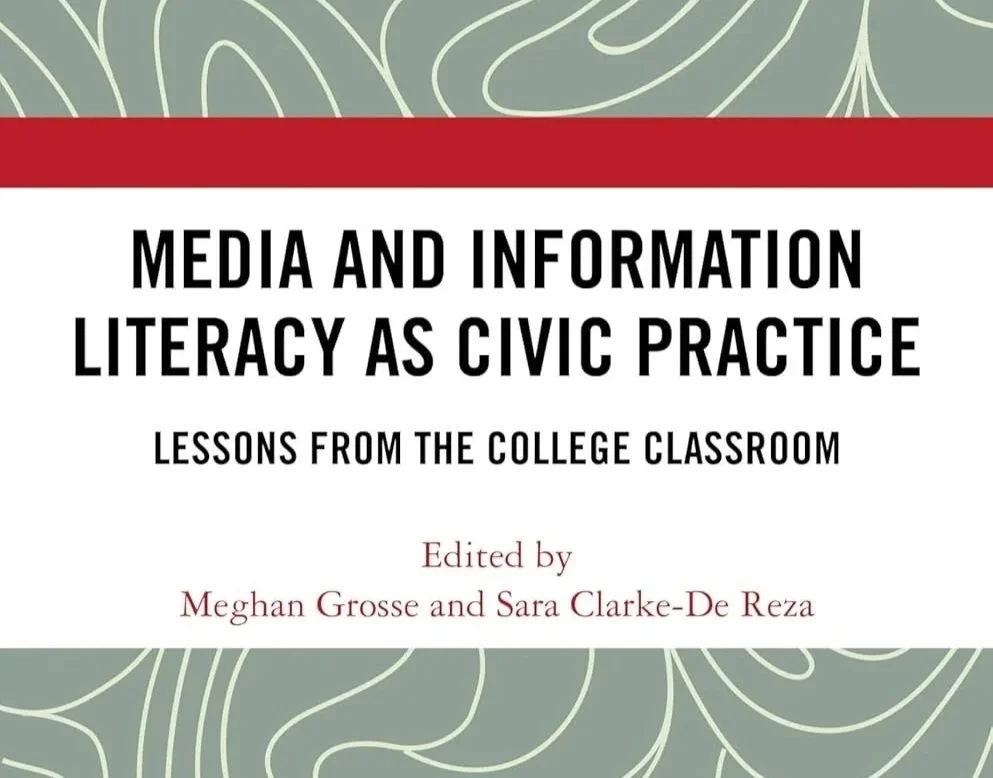
Meghan’s most recent work, as first editor and author, appears in the 2026 edited volume Media and Information Literacy as Civic Practice: Lessons from the College Classroom (Routledge, 2026). Responding to increasingly complex media environments and myriad crises in our democratic systems, this book foregrounds the importance of teaching students media and information literacy skills to prepare them for a life of active citizenship. Through a series of case studies, this book shows how media and information literacy can be integrated across the curriculum.
This volume, available for pre-order now, is ideal for college and university educators who are looking to integrate civic and information literacies into their undergraduate teaching, as well as graduate students preparing for careers that include postsecondary teaching.